

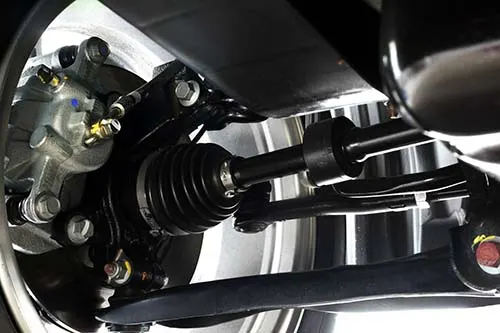
CV Axle Shaft Assembly
What are my CV Axle Shaft Assemblies?
When you’re driving your vehicle, have you noticed a wobbly or shaking sensation in the steering wheel? How about hearing that funny clicking sound coming from the front wheels as you are turning a corner? Sometimes it can from the back of the car under the same turning situation. That sound is an audible warning to the driver that the CV axles need some attention. CV stands for Constant Velocity shafts or axles. These can also be referred to as half shafts or drive shafts. They are the part of the drive train assembly that transfers power from the engine and transmission to the wheels to make your car move.
When the engine in your vehicle is started and running, it produces energy and motion that needs to be delivered to the driving wheels of the car to make it move. This transfer of power goes thru the transmission and then on to the wheels by way of axles and CV joints.
What happens when the CV Axles start to wear down?
Generally there are four basic parts of a CV axle shaft assembly and they are not complicated to a trained certified mechanic. They start out with the axle shaft, which is connected to the wheel hub, the CV joints which are attached to the axle shaft and a good amount of grease to keep the CV joints lubricated and a protective rubber boot over the CV to keep the grease in and the dirt out.
Some cars have multiple CV axle joints in the drive train assembly. Over time, the most common part to fail is the rubber boot. This will leave a telltale sign of leaking grease in that area. Sometimes when this happens, dirt and other debris can get into the CV joint causing extensive damage.
CV Axle Shaft Assembly Repair or Replacement
Repairing and replacing these parts will require a few specialized tools to reassemble and tighten the bolts to the correct torque. Because of that, it is not recommended for the backyard DIY repair.
Any repairs performed at our shop will include complete installation of all necessary parts. During reassembly, all new parts will be torqued to required specifications. A road test will be done to verify the safety of the vehicle.
Other areas that we will check that are related to the CV Axle Shaft are the suspension system, the wheel bearings and condition of your vehicles tires.
At Workman’s European Auto our certified technicians will make an evaluation on what repairs should be performed to get your car operating safely again. Schedule an appointment today!
Top 10 frequently asked questions (FAQs) about CV axle shaft repair:
1. What is a CV axle shaft?
The CV (Constant Velocity) axle shaft is a component of the drivetrain in front-wheel and all-wheel-drive vehicles. It transfers power from the transmission to the wheels, allowing them to move.
2. What are the common symptoms of a failing CV axle shaft?
Common symptoms include:
- Clicking or popping noises when turning
- Vibration during acceleration
- Grease on the inside edge of the tires
- Knocking or clunking sounds
- A humming or growling noise
3. Can I drive with a bad CV axle?
It’s not recommended to drive with a bad CV axle as it can lead to further damage to your vehicle’s drivetrain and increase the risk of a complete failure, which can be dangerous.
4. How long does a CV axle shaft last?
CV axle shafts can last anywhere from 50,000 to 100,000 miles or more, depending on driving conditions, maintenance, and vehicle type.
5. What causes CV axle failure?
Common causes include:
- Torn CV boot, leading to loss of grease and contamination
- High mileage wear and tear
- Impact damage from potholes or accidents
- Lack of regular maintenance
6. Can a CV axle be repaired, or does it need to be replaced?
While CV boots can sometimes be replaced if caught early, a damaged CV axle typically needs to be replaced as the internal components cannot be easily repaired.
7. How much does it cost to replace a CV axle shaft?
The cost varies based on the vehicle make and model, but it generally ranges from $150 to $450 per axle, including parts and labor.
8. Is it possible to replace a CV axle at home?
Yes, with the proper tools and mechanical knowledge, it is possible to replace a CV axle at home. However, it is a complex task that requires significant time and effort.
9. What tools are needed for a CV axle replacement?
Common tools include:
- Jack and jack stands
- Socket set and breaker bar
- Torque wrench
- Pry bar
- CV axle puller or slide hammer
- Hammer
- Pliers and screwdrivers
10. How can I prevent CV axle failure?
Regularly inspect the CV boots for tears or leaks, keep your vehicle properly maintained, avoid driving through deep water or mud, and drive cautiously to avoid impacts that could damage the axle.
If you have any more questions or need further details, feel free to ask!